For most of the western world, the term Africa often brings a few specific things to mind…such as poverty, conflict, and HIV/AIDS. Though it would seem that these issues would be very apparent, that is far from the case. Yes, looking from the outside in it appears that each and every day in Africa is just a struggle to survive, but for them it’s just life…what they do, how they live. So, though I have been in Uganda for three months, the presence of HIV/AIDS has never been overly noticeable to me. It is just a part of African life…a part that many Africans choose not to address.
The weekend of March 20th finally gave me the opportunity to recognize and examine the mass impact this devastating disease is having on Sub-Saharan Africa. That Friday afternoon, the students of IMME piled onto our coaster bus and headed two hours northwest to the Luwero district. After a relaxing night at a local guest house, we were all more than ready for the day before us…so we thought.
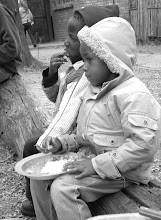
Saturday was one of the hardest ‘fun’ days of my life. Spending an entire day playing with African children is enough to make anyone blissful…but when the children are HIV positive, it’s a struggle to look at each happy little face without tears coming to your eyes. In past semesters, the USP students have visited these same children and sat with them, talking about their illness and the hardship they face. This semester, though, we decided to do something little different. The children hated having to talk about it…for there is no hope for them. Talking about it all day simply reminded them about the path they were on. Instead, we spent the day giving them a little joy…playing games, eating good food, and learning traditional Buganda dances…to let them forget, if only for a few hours, what their future holds.
It truly was fun to play with them. We divided into four different groups and competed all afternoon in various activities. We did the more common activities, like the sack race, walk-with-an-egg-on-a-spoon, and three-legged race (which Kristin and I won!). My favorite activities, though, were the more traditionally African contests. These included seeing who could peel 10 matoke bananas and dress a girl in a gomaz (traditional Uganda dress) the fastest. The Ugandans in our groups were also given the responsibility of teaching the Americans a traditional Bugandan dance, which was so much fun to learn. It was thoroughly amusing watching my American friends attempt to shake their hips like Africans do. We truly are horrible dancers. =)
At the end of the day, the points were all added up and each team sat in anticipation for their score, hoping that they could claim the honor of first place. You can’t even imagine the excitement and joy of my team when they announced us as the winners. Everyone was jumping, shouting, laughing, and hugging…thrilled with our success. It was so loud and so exciting. I was so happy for our little children…that they could be so happy. When I think of it now, it seems fitting that my team’s name was Unity. We came together that day…Ugandan and American, HIV positive and healthy, poor and ‘wealthy’, hopeless and hopeful… We all joined hands as one, to fight the stigma of AIDS…to show that this isn’t a battle they have to face on their own.
In Africa, being HIV positive is very taboo. Everyone knows how the disease spreads, so there is a stigma on those who have it. There is also a great deal of fear, for though people realize you can’t get it by simply touching someone with HIV, people are still afraid they could contract it anyway. Because of this, it is very common for people who are HIV positive to not tell anyone. In fact, it is also common to find that many Africans simply don’t get tested. It seems strange to an American mind to not get tested when there’s a possibility of you being sick…but in Africa, where people realize there is no hope for them…to access effective medication or even survive…they choose to remain oblivious in hopes of living their life as happily as possible.
I must admit that I myself fit within the category of scared people to some degree. It’s natural for people to fear catching an incurable disease; however that doesn’t mean those who have it should be shunned or treated as less than human. Looking into the eyes of people who I know are HIV positive showed me just how human they are, and how pathetic my perceptions regarding them had been. They are just people…facing the reality of their own painful death. They need support and friendship, not fear and avoidance.
HIV/AIDS is a massive pandemic facing the entire world. However, it is Sub-Saharan Africa that is the most disturbed by it. In fact, it is commonly believed to have originated in the Rakai district of Uganda…a place I have visited during my stay here. Though scientists are unsure exactly how it began, HIV has spread exceedingly fast within the past 30 years. To give you a small idea of how affected Africa is by HIV/AIDS, I’m going to give you a few statistics. In American, there is an estimated 1.5 million people infected with HIV. In Sub-Saharan Africa, there is an estimated 22 million people infected…and the number is only increasing.
It’s been interesting to learn about this issue while in Uganda, for out of all African nations, Uganda is know world-wide for its affective advertisement campaign regarding AIDS, promoting abstinence and safe sex. It has been praised for bringing the percentage of new infections to a stand still in many ways. Yet, HIV/AIDS is still very prevalent here.
Following my weekend with children infected with the disease, I decided to talk to talk to my family about the topic…to learn their ideas, views, and perception of AIDS. One night, I sat down with my 19 year old brother, Sam, and spent two hours discussing the reality of HIV/AIDS in Uganda...in Mukono-town. Because it is well-known that HIV/AIDS is most commonly spread through unprotected sex, a lot of our conversation revolved around peer pressure.
Sam told me that almost all his friends and the people his age tend to idolize football (soccer) players. In fact, all the young men want to be ‘footballas,’ as Sam would say. As they watch the common behavior and lifestyle of famous football players…the parties, drinking, wealth, nice cars, and pretty women…young Ugandan men get it in their minds that all they have to do to be a ‘footballa’ is to get involved in those things. Because obtaining the wealth and prosperity isn’t always possible in such a poor nation, they go after the most obtainable thing…the women. I was told by Sam that on numerous occasions he has been pressured by friends to ‘get with a girl’ because that’s what ‘footballas’ do. Nevermind the immense risk of contracting HIV, if it’s what ‘footballas’ do, then you have to do it to be cool as well. As I listened to him tell about the pressures he faces each day, I couldn’t help but be amazed by his fortitude. Sam has one of the sweetest spirits I’ve ever seen. Seeing his conviction and passion about remaining pure…not only for safety reasons, but also out of a longing to find just one young woman to love and marry…I realized just how much God had blessed me with my Ugandan family. Throughout the semester I’ve had many conversations with other IMME students about the promiscuity they have observed within their Ugandan families, and I am so thankful that God put me with a family where I would be able to see HIV/AIDS prevention at its finest.


- Tori
- The purpose of life is to live it, to taste experience to the utmost, to reach out eagerly and without fear for a newer richer experience. -Eleanor Roosevelt
No comments:
Post a Comment